Resource Center
You can access all the sources of information on our site from this web page.
Resources are divided into 5 Sections :-
Deity Database Listings in Tabular & Full Page Layouts
Articles & Papers on our Website
Links to Articles on External Sites
Videos on External Site
Interesting Websites
A number of the Articles, along with the "How to Use our Site" Guides are available for Download from our Download Centre.
Xian Shen - Chinese Deities
Chinese folk religion simplified Chinese: 中国民间信仰; traditional Chinese: 中國民間信仰; pinyin: Zhōngguó mínjiān xìnyǎng is the most widespread form of religion in China, and Taiwan as well as among the Chinese diaspora. It is the ethnic religion of the Chinese people, and involves veneration of forces of nature and ancestors, exorcism of harmful forces, and a belief in the rational order of nature, the universe and reality that can be influenced by human beings and their rulers, as well as spirits and gods.[1] Worship is devoted to a multiplicity of gods and immortals (神 shén), who can be deities of phenomena, of human behaviour, or progenitors of lineages. Stories regarding some of these gods are collected into the body of Chinese mythology. By the 11th century (Song period), these practices had been blended with Buddhist ideas of karma (one's own doing) and rebirth, and Taoist teachings about hierarchies of gods, to form the popular religious system which has lasted in many ways until the present day.[2]
Ancient Chinese religions have a variety of sources, local forms, founder backgrounds, and ritual and philosophical traditions. Despite this diversity, there is a common core that can be summarised as four theological, cosmological, and moral concepts:[3] Tian (天), Heaven, the transcendent source of moral meaning; qi (氣), the breath or energy that animates the universe; jingzu (敬祖), the veneration of ancestors; and bao ying (報應), moral reciprocity; together with two traditional concepts of fate and meaning:[4] ming yun (命運), the personal destiny or burgeoning; and yuan fen (緣分), "fateful coincidence",[5] good and bad chances and potential relationships.[5]
Yin and yang (陰陽) is the polarity that describes the order of the universe,[6] held in balance by the interaction of principles of growth (shen) and principles of waning (gui),[7] with yang ("act") usually preferred over yin ("receptiveness") in common religion.[8] Ling (靈), "numen" or "sacred", is the "medium" of the two states and the inchoate order of creation.[8]
The present day governments of both China and Taiwan as well as the imperial dynasties of the Ming and Qing tolerated village popular religious cults if they bolstered social stability but suppressed or persecuted those that they feared would undermine it.[9] After the fall of the empire in 1911, governments and elites opposed or attempted to eradicate the ancient Chinese religion in order to promote "modern" values, and many condemned "feudal superstition". These conceptions of the ancient Chinese religion began to change in Taiwan in the late 20th century and in mainland China in the 21st. Many scholars now view folk religion in a positive light.[10] In recent times the ancient Chinese religion is experiencing a revival in both China and Taiwan. Some forms have received official understanding or recognition as a preservation of traditional ancient Chinese culture, such as Mazuism and the Sanyi teaching in Fujian,[11] Huangdi worship,[12] and other forms of local worship, for example the Longwang, Pangu or Caishen worship.[13]
Deity Database
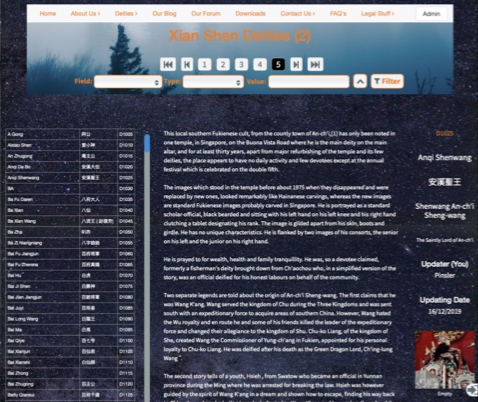
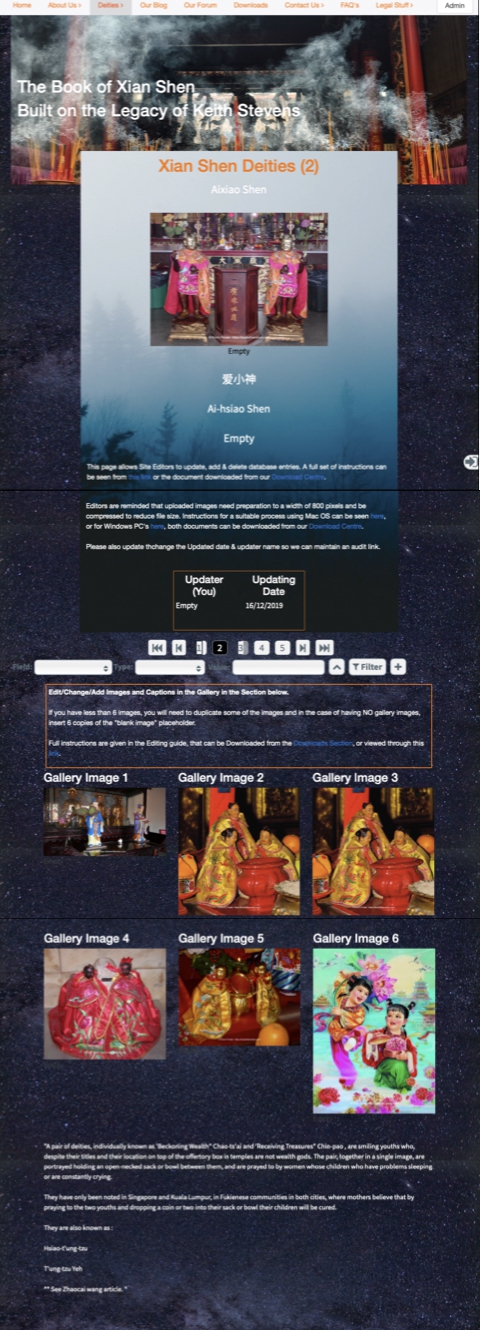
The Deity Database includes names in Pinyin, Mandarin & Wade Giles styles, along with biographical details and images, it can be accessed through a number of styles giving differing levels of content, from a simple listing to full page layouts.
Tabular Listings
The Main Tabular Format provide a sub-set of the database just including names in Pinyin, Mandarin, WadeGiles along with Deity Titles, a thumbnail image where available and the biography. It is ideal for searching and initial research.
The second version includes all the database fields, but is mainly intended for Designated Database Content Editors.
Full Page Listings
The Full Page Listing provide all the database information on one Deity. It is fully searchable, there are two versions, one with a sidebar listing all the individual deities and another without the sidebar.
Articles & Papers
The following papers can be accessed through the following links. Copies can be downloaded from the Download Centre.
External Resources
External Resources provides links to interesting and related websites, articles on other websites and videos.